
Service area
BBQ Catering forSparks, Nevada
The city grew up around the Southern Pacific yards and it still works for a living. The warehousing, distribution and light industry on its east side employ people across shifts, and that single fact changes how a cater here gets planned: a workforce does not all sit down at once.
- Distance from our base
- about 29 miles northStraight-line from 5110 S Edmonds Dr, Carson City — not a road distance.
- County
- Washoe County, Nevada
- Good to know
- An incorporated city in Washoe County, adjoining Reno — founded as a Southern Pacific railroad town and still built around its industrial east side.
Feeding a workforce that works in shifts
The events we get asked about up here are mostly employer-run — an appreciation lunch on the yard, a safety-milestone cookout, a holiday party in a bay cleared for the afternoon, a customer open day. The person organising it is usually the same person who has to keep the operation running while it happens, which is a different brief from a private party.
Nobody is going to stop a distribution floor for two hours so that everyone can eat together. The line has to serve one group, hold, and serve a second without the food being twice-cooked or twice-cold — a scheduling problem as much as a catering one, and the thing most worth telling us at the enquiry rather than on the morning.
Two cities, two sets of paperwork
Sparks and Reno run into each other on the ground and almost nobody from outside Washoe County can say where one stops. On paper they do not overlap at all: separate councils, separate parks departments, separate business licensing, separate special-event rules.
That matters to you in one practical way. If your event is on public ground or needs any sort of permission for an outside vendor to work, the office you call is the one for the city the site is actually in — and an address a few blocks either way can change the answer. It is the slowest-moving part of an event like this, so start it before you start on the menu.
A serving line goes where the work is
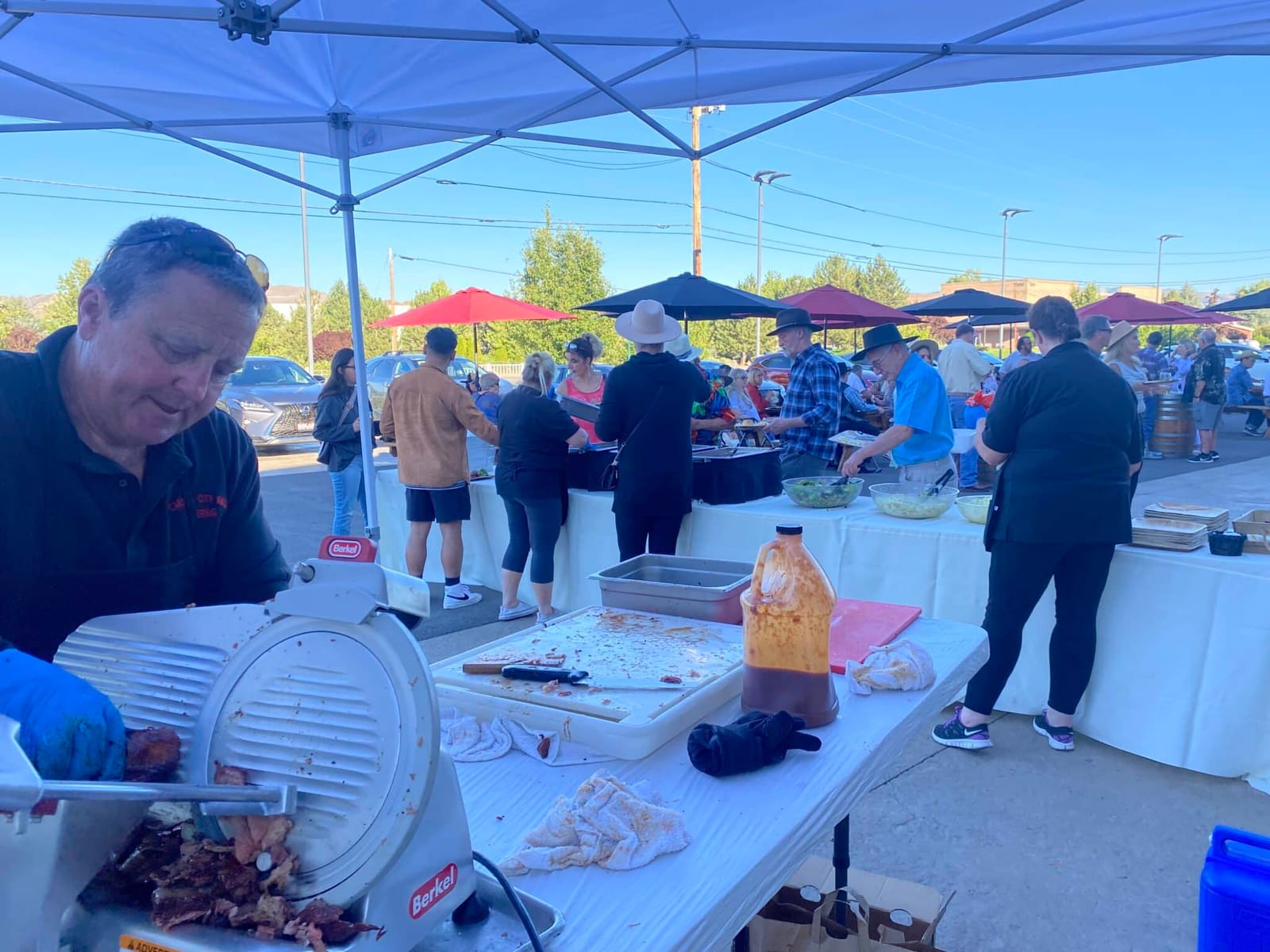
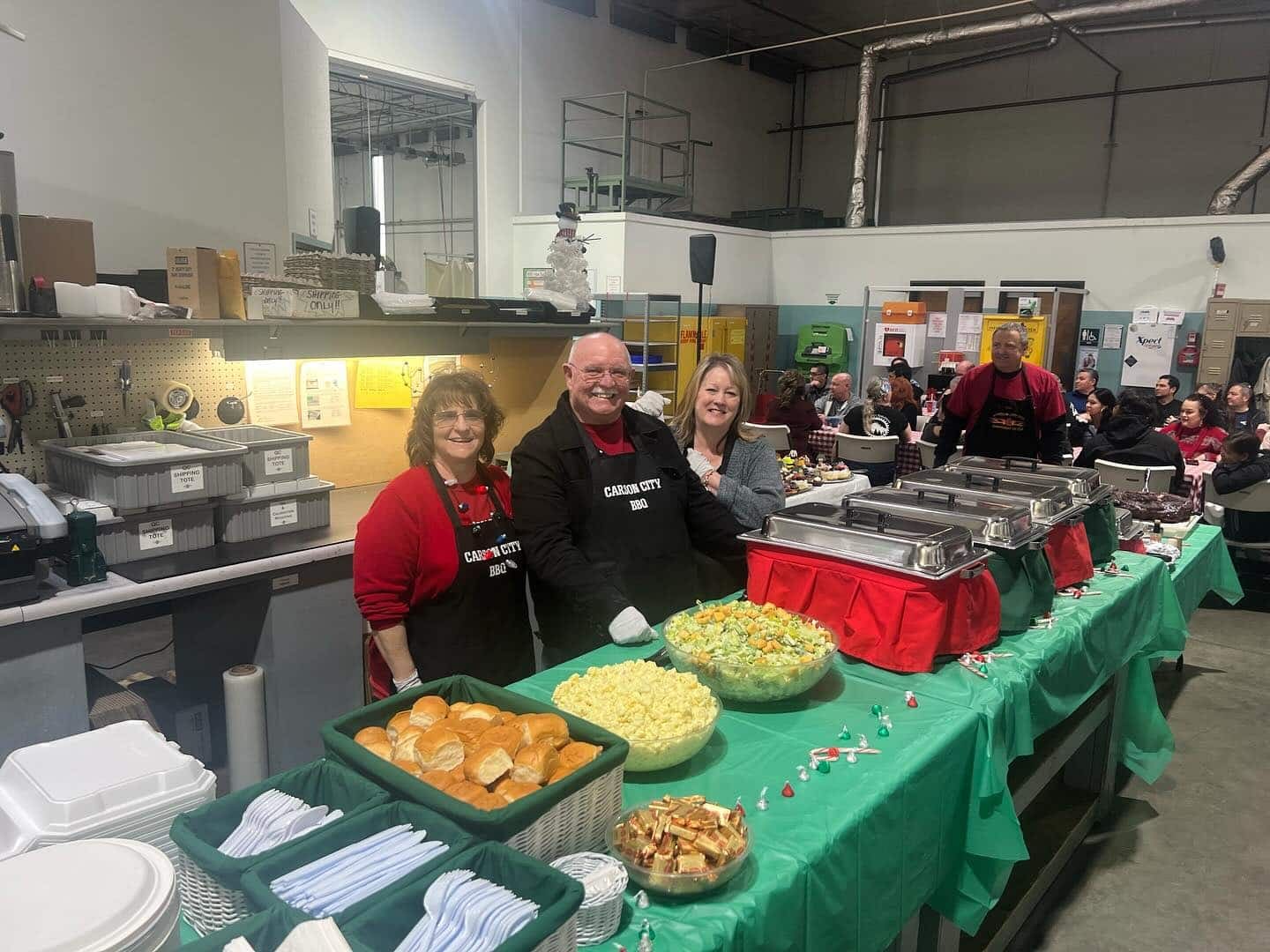
A cater on a working site does not need a room. The line sets up on whatever floor is free — a bay cleared for the afternoon, a yard, an area beside the break room — and the tables to serve on and the tents to serve under, if it is outside, arrive with the crew.
Warmers are the unglamorous half of the kit and the reason a shift pattern works at all. The first group eats what has just come off the cooker, and what is held back for the second group is held properly rather than left on a table to go cold while the floor finishes up.
What the published terms mean for a shift pattern
Standard service covers a two-hour serve window. That is ample for a single seating and it is the first thing to hold up against a shift pattern, because a site that eats at eleven and again at two is asking for more than two hours of service. Extra serve time can be added — our printed terms say so, and they say it carries an additional fee.
Where the line stands is the other question, and on a working site it is not a free choice. Yard traffic, a dock still in use, a gate somebody has to open, and a rule about where an open flame may sit will all narrow the options before anyone thinks about tables. Tell us those constraints early and the set-up is planned around them instead of negotiated on the day.
Which tier fits an employer's day
Full service, and for a reason that has nothing to do with headcount. A shift pattern needs food held at temperature and served more than once, which is exactly what a crew, warmers and a cooker already on site are for; a drop-off is one delivery at one time, and the second group eats whatever is left of it. The published floor for a full cater is 40 people, and an employer feed usually clears that without trying.
What we usually suggest here
Full-service catering
20-person minimum for drop-off and pick-up · 40-person minimum for a full cater. Every event is quoted individually.
Travel fees are added to caters outside our immediate area.
Tell us the date and the shift pattern
Send the date, a headcount and — if your people eat in more than one group — the times they come off the floor. Say where on the site you want them fed, and the quote will cover the travel fee our printed terms apply this far out, along with any extra serve time a second sitting needs.